
Your Design System Is the Instruction Manual for AI-Coded Products
Your design system is the machine-readable context that turns AI from a guesser into a consistent builder.
Sixty-eight percent of developers now use AI to write code. Only 32% say they trust the output enough to ship without significant review.
That gap is a design problem and most design teams haven't connected it yet.
The trust problem isn't primarily a model problem. Models can generate technically correct code. What they can't do on their own is generate your code - code that reflects your design decisions, your token system, your component hierarchy, your brand. When an AI coding agent doesn't have that context, it guesses. Those guesses compound across every surface, every component, every iteration. What used to be a localized inconsistency becomes a systemic problem that scales at machine speed.
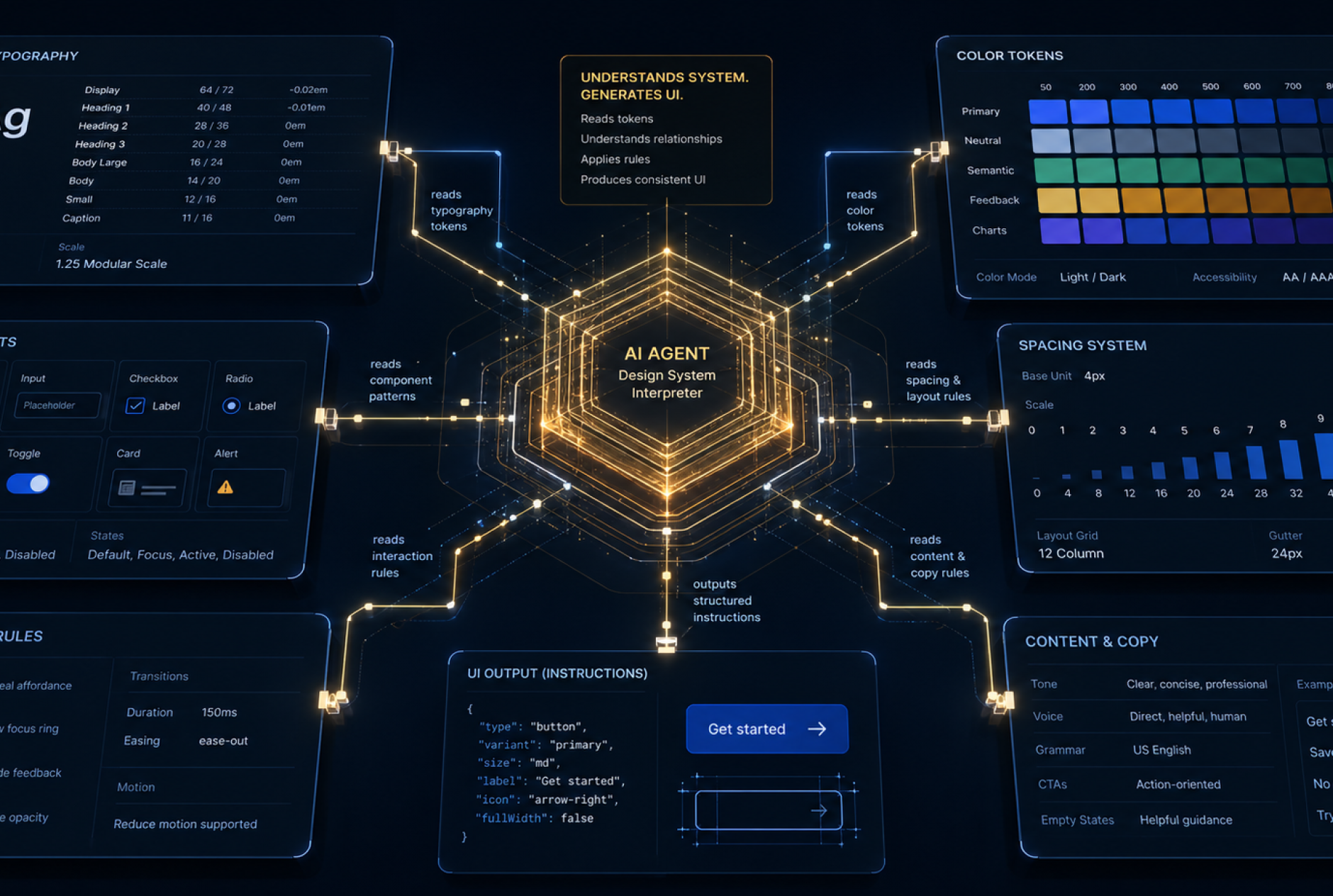
Figma's MCP server changes the equation. When an AI coding agent connects to your design system through a structured API, it's not reading screenshots anymore. It's reading decisions. It knows what your primary button looks like and why. It knows your spacing scale, your color tokens, your type ramp. It has the context it needs to generate code that's on-brand, consistent, and actually reflective of the system you built.
Context goes up, trust goes up. The relationship is direct.
Design systems have always been about reducing inconsistency. The traditional argument was about the design-to-engineering handoff: if everyone works from the same source of truth, you get less drift between what was designed and what shipped. That argument held for a decade and drove real investment in component libraries, token systems, and documentation.
The new argument is more urgent. Your design system is now a machine-readable instruction set for AI agents that will write code at a scale and speed no human team can match. If those agents don't have your system as context, they'll invent one. They'll make choices about spacing, color, and component behavior that drift from your brand in ways that are hard to catch and harder to reverse.
A well-maintained design system used to give you consistency across designers, now it gives you consistency across AI agents too. The surface area just got much larger, and so did the stakes.
This is not a reason to panic about AI in your codebase. It is a reason to treat your design system as infrastructure, because that is what it is now: not documentation or a handoff artifact, but an instruction set. And like any instruction set, the quality of the output depends entirely on the quality of the input.