
Designers Are Becoming Translators and Driving Impact
The designers who thrive in the AI era won't just make things. They'll translate between what systems produce and what people actually need, and that translation is the real design work.
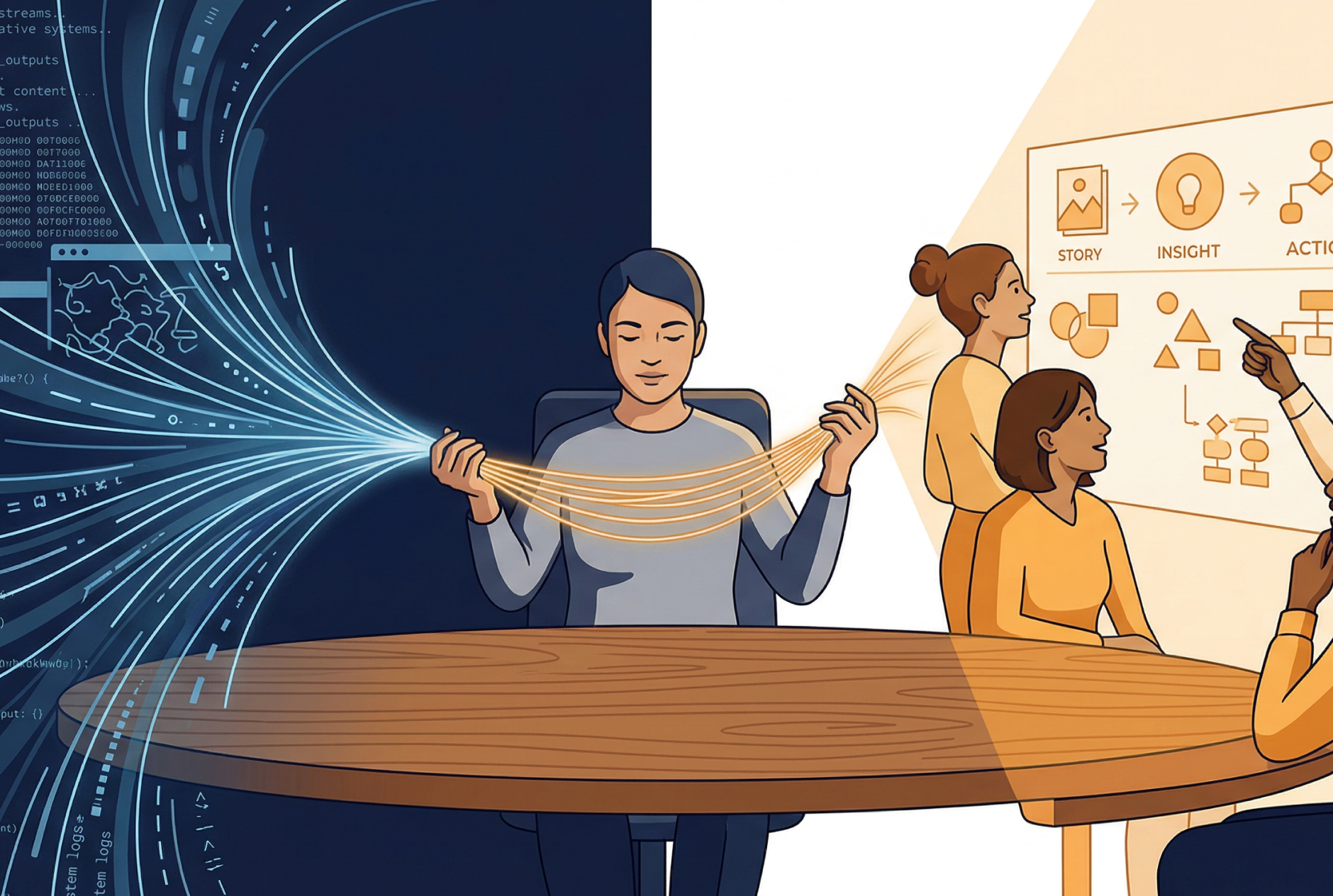
In almost every product review, there's a moment where someone presents a slide full of screens, everyone in the room nods, and then something wonderful happens. The screens aren't just correct; they help people bridge the gap between what they're seeing and the decision in front of them.
That gap has always existed, and designers have always worked to close it. Turning ambiguous user research into a product direction, turning a stack of data into a prototype someone can react to, translating between what users need and what engineers can build. The translation has always been the job. The tool used to be the screen.
The tool is evolving.
AI systems generate enormous amounts of output. Models make recommendations, flag anomalies, take autonomous actions, optimize for outcomes. Much of that output is becoming increasingly visible to the people who need to make sense of it. A data scientist can explain what a model did. An engineer can show what the system returned. And turning that output into a story a VP can act on, connecting system behavior to user experience to business value in a sequence clear enough to drive a decision, that is translation work. And designers are uniquely positioned to do it well.
The users benefiting from AI output are starting to experience this opportunity. A recommendation arrives with clear explanation. A boundary appears with helpful context. A process completes and the user can confidently tell that the right thing happened. The experience reflects good design: the presence of a translation layer between what the system did and what the person needed to understand.
Designers are trained for exactly this. Not for AI specifically, but for the underlying opportunity: making something opaque legible to someone who needs to act on it. That skill, the ability to take complexity and render it as a coherent narrative, does not require the output to be a screen. It requires attention to the person on the other end. What do they know coming in? What do they need to understand? What would make them confident enough to act?
The new translation job is more rewarding than the old one, and it is recognizable. It starts with system behavior: what did the model decide, what signals drove that decision, what confidence level was attached to it? It moves through user experience: what did the person encounter as a result, what did they understand, what enhanced their experience? It ends at business value: what did this cost or create, and what can we build on as a result?
No deck of screens required. The story is built from observation, from data, from the kind of close reading of user experience that practitioners have always done. And it is aimed at executives and engineers who are eager to make decisions about systems they're learning to see more clearly.
This is where designers have an opportunity that didn't exist at this scale before. Not because other functions are falling short, but because other functions were built for different problems. Data teams are excellent at explaining what systems do. Product teams are excellent at prioritizing what to build next. What is emerging as valuable is the layer that connects those two things: the narrative that says, here is what the system did, here is what users experienced as a result, and here is what the alignment between those two things is creating for us.
Designers who can produce that narrative are not decorating outputs. They are the decision-support layer for teams operating complex systems at scale. Executives managing AI-powered products value that layer. They are asking for more than screens. They are asking for someone who can show them what is actually happening to the people their systems serve.
The skill of making invisible systems legible to the people who use them, and to the people who build and fund them, has always been central to design. It is not a new skill. It is the most enduring skill the discipline has, applied to an exciting new kind of artifact.
A system that operates autonomously, that acts on users without visible interfaces, that generates outcomes with clear explanations, benefits from what every complex system has always needed: someone who can see what it looks like from the user's side and make that visible to everyone else. That is not a screen. It is a story.
The work ahead is about embracing influence while everything evolves. It is about using the capability design has always had, staying close to people, making complexity legible, building bridges between what systems do and what humans experience, and pointing it at the opportunity that is right in front of us. The users on the other end of these systems benefit from someone in that room. Designers are the right people for that job. Not because they claimed it. Because they've been doing the work all along.