Upstream by Design: The Infrastructure Behind Real Influence
Design influence grows when you’re in the conversations that shape decisions, not just the ones that ship them.

The designers with the most influence in large organizations tend to have one thing in common.
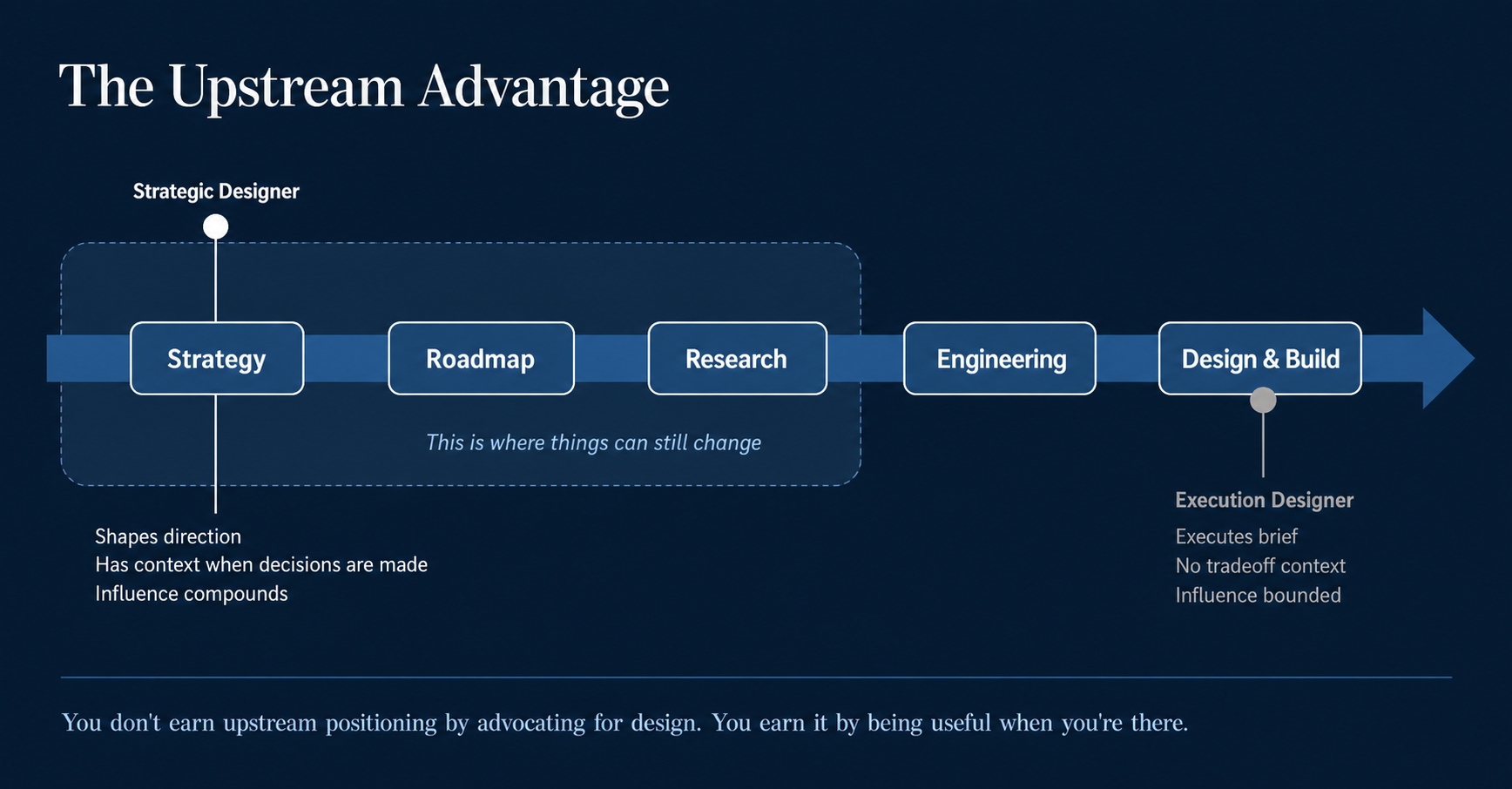
They're upstream.
Present when strategy is still being argued, not when it's being announced. They see the product roadmap while it's still a set of options, not after it's locked. They're in the competitive intelligence conversation as it's happening, not catching up from a three-week-old summary.
That's not seniority. It's positioning.
Most organizations bring design in at the execution stage: “Here’s what we’re building. Make it look good.” That is a common setup, not a judgment about design’s value. But it creates a gap. Designers who move upstream and help shape decisions early become much harder to ignore.
The difference between design having influence and design getting consulted is mostly whether you're present while things are still being figured out. Not because designers need to weigh in on every decision. Because the reasoning is better when someone who understands user behavior is part of it before direction is set - and people figure that out pretty quickly once it's happened a few times.
"Getting a seat at the table" implies there's a moment, some meeting where you finally get invited to speak. Influence doesn't really work like that. It's built from the information you already have when the decisions are happening. Showing up with a well-reasoned argument after the fact doesn't move much.
So the actual move is about which conversations you're in, not how well you perform in them.
Roadmap planning is the obvious one. Get in before the roadmap exists - not for the slide that gets presented, but the reasoning behind it: the customer signals, the market bets, the options still being weighed. Whether those bets are sound is something a designer who understands user behavior can actually assess. That's a useful contribution, but only if you're there for it.
Resource conversations with finance matter more than most designers realize. Staffing decisions, budget constraints, timeline pressure - all of it shapes what's designable before a single brief is written. Understanding those constraints as they're being set is different from inheriting them as requirements later.
Customer research is worth getting into before it's packaged. Raw feedback, usage data, behavioral signals. There's a meaningful difference between forming your own read alongside the team and receiving a polished summary that's already been filtered through someone else's interpretation.
Engineering prioritization is worth knowing before sprints lock. Not to slow anything down, just as information. What are they solving for? What's about to become possible as the infrastructure changes? Those are design variables. Knowing them early is almost always useful.
Competitive analysis is similar. The useful part is in the interpretation, and that mostly happens in the room when it's being done, not in what gets shared afterward.
None of this is extra work. It's just a different version of the job.
You don't earn that kind of positioning by advocating for "design involvement." You earn it by being useful when you're there - hearing a product strategy discussion and immediately knowing what it means for user behavior, seeing a budget constraint and knowing which design approaches it opens up or rules out, reading research and surfacing the UX angle before anyone thinks to ask.
That's the gap between executing a brief and helping write it. Strategic designers aren't upstream because they pushed their way in. They're there because the conversations got noticeably better when they started showing up.
For more on this topic, see a previous article: https://www.tateux.com/writing/the-product-triad